Supporting the Real Economy and SME Financing
The European Awakening
Europe’s postwar model, anchored in the imperative of the continent’s reconstruction, offered social security, industrial strength, a harmonised legal and regulatory setting, while delivering prosperity and political stability, for decades. However, its heavy structures – suited to an era of slower change and national economies – are now coming under pressure from intensifying demographic trends, productivity languishing for years under the weight of an increasingly complex legal environment, and a shifting global order calling for a more competitive and self-reliant Europe.
Regarding competitiveness, concerns are not new, as business leaders have long warned of underinvestment, slow digital adoption, stringent ESG requirements, and declining industrial resilience. However, the publication of flagship reports by Mario Draghi, Enrico Letta, and Christian Noyer, led Brussels to officially frame this stagnation as a strategic emergency.1 Unfortunately, since the publication of such reports and despite the urgency
of action, few concrete initiatives were undertaken. A recent report issued in June 2026 by Oliver Wyman and the European Banking Federation, shows that the investment needs of the EU to restore its competitiveness, has even risen to € 1.4 tn per year (up from the 800 bn estimated in the 2024 Draghi Report). This is because of higher defence spending and continued energy transition investment.
European defence, long treated as a marginal budget line, is since Russia’s 2022 invasion of Ukraine and the strategic rupture emerged from Washington seen as a matter of sovereignty. The political response is converging and the firm commitment of both the EU and NATO members is concrete and on-going. On the regulatory front, the various Omnibus packages launched since 2025, aim to boost competitiveness and simplification in fields such as sustainable finance, digital and capital markets. Some of the measures shall reduce complexity of EU requirements for all businesses, notably SMEs and small mid-caps. At the time of writing, the publication of the EC report on the competitiveness of the EU banking sector was published in mid-July 2026. Such report, following a public consultation that concluded last April, suggests targeted interventions in the whole basket of EU legislation in order to boost its effectiveness, also vis-à-vis other economic aeras at global level. Legislative proposals with concrete interventions to reinforce the banking sector’s resilience and effectiveness are expected to be published in 2027.
However, regulatory streamlining, while necessary, is not enough. In contrast to the U.S., where capital markets dominate, Europe remains a bank-financed economy, especially for SMEs. As a response, the Capital Markets Union developed into the broader Savings and Investments Union (SIU), with a more holistic approach encompassing the entire EU financial system, whereby capital markets and the banking sector together will enhance
the efficient channelling of savings into investments.3 Securitisation, with its legal framework currently under trialogue discussions among EU legislators, plays a role in placing traditional bank loans’ underlying risk with capital market investors.
The creation of a business-friendly environment is crucial. The scale of required investments for the deployment of this new and enhanced industrial capacity means it’s hardly achievable without the private sector, financed by both the capital markets and the European banking sector.That is why the attention is turning to Europe’s industrial backbone: its SMEs. Taking the defence sector for example, in the Joint White Paper on European Defence Readiness 2030, the European Commission identifies SMEs as key providers of innovation and agility in defence technologies. The €7.3 billion European Defence Fund (EDF) for 2021–27 explicitly supports SME participation, with €840 million estimated for the 2023–2027
period. Already, more than 2,500 SMEs are embedded in Europe’s defence supply chains4.Another sector where SMEs also play a key role in the production of components, combining advanced manufacturing, high technology, specialised services and scientific research, is the aerospace. The space economy is a fast-growing sector, where public support and banks financing is crucial, also through risk sharing mechanism.5
More broadly, meeting the EU’s competitiveness, energy, technology, aerospace and defence ambitions will require an estimated €500 billion in additional annual investment.6 This is a political and institutional challenge that will define Europe’s future.
In the next sections, we will examine how Europe might begin to close this gap: first, by understanding the needs and potential of SME financing; and second, by retooling its financial infrastructure through instruments like European Secured Notes (ESNs) and securitisation technology – so that European loans and savings can be converted into European investments, growth and prosperity.
Trends in Firms Financing
European firms, particularly small and medium-sized enterprises, still rely heavily on bank lending, but the ongoing trend towards diversification of funding sources is gradually leading to significant structural changes, in line with the objectives of the Savings and Investments Union (SIU).
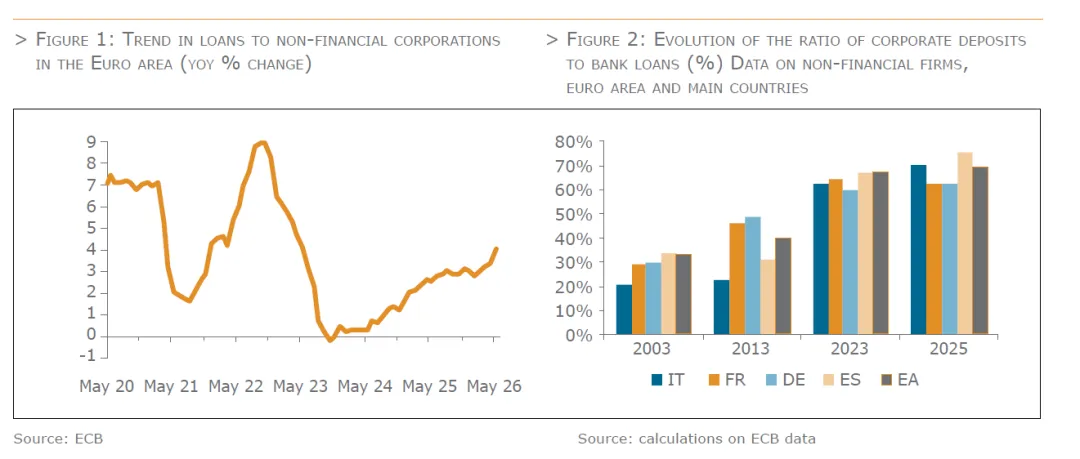
2025 and the first part of 2026 saw a gradual recovery in bank lending to businesses. The growth rate of loans to non-financial corporations in the euro area accelerated to 3.0% year-on-year in December 2025 and to 4.0% in May 2026, up from 1.7% at the end of 2024, reflecting a widespread trend across the euro area countries. This trend was driven by lower interest rates, although the global economic and geopolitical environment
remained characterised by high uncertainty, which held back fixed investment. Furthermore, there is evidence that the recovery in bank lending was more robust amongst larger firms, whilst lending to small and micro-enterprises remained weaker.
The ECB’s Survey on Access to Finance (SAFE) shows that demand for bank loans was more prevalent among large firms than among SMEs: specifically, in the first quarter of 2026, the proportion of large firms applying for bank loans stood at 27%, in line with the average for the previous three quarters, whilst for SMEs it remained at 17%. In both business size segments, loan demand in 2025 was stronger than that recorded by the survey
in 2024. The low demand from smaller firms would appear to reflect a general aversion to risk and a preference for a cautious and gradual growth path rather than one supported by credit. This is indirectly demonstrated by the increased liquidity of firms, which continued to record robust growth in their bank deposits (+4% year-on-year at the end of 2025 and in May 2026).
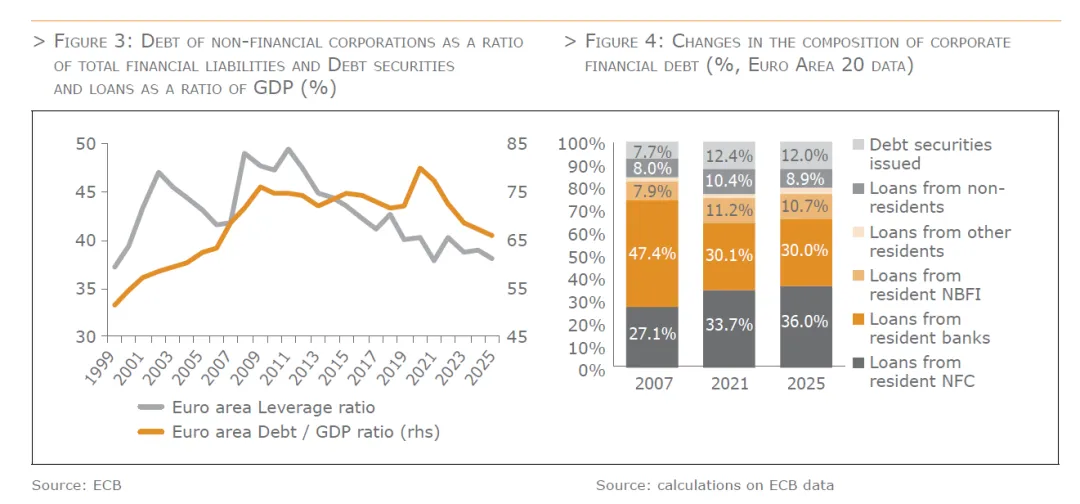
The most recent developments form part of a long-term trend which, since the Great Financial Crisis, has led to a substantial change in the financial structure of firms, characterised by a strengthening of capitalisation and a parallel reduction in financial leverage, accompanied by a restructuring of liabilities, following the increased issuance of corporate securities and credit sourced from non-bank financial intermediaries.
Financial leverage has fallen from 49.0% in 2008 to 38.1% in 2025 for non-financial companies in the euro area, thanks in part to their stronger capitalisation. In addition, the composition of financial debt has changed: between 2007 and 2025, the share of bonds has grown from 7.7% to 12% of total financial debt; bank financing has declined, from 47% in 2007 to 30% in 2025, whilst debt exposure to non-bank intermediaries (from
7.9% to 10.7%) and to foreign sources of financing has increased.
In recent years, we have also witnessed a significant and structural increase in the level of corporate liquidity, which has been observed across all countries and company sizes. In particular, firms in the euro area have, in recent years, saved more than they have allocated to fixed investment. The financial balance between flows of assets and liabilities has been positive overall, and self-financing has proved to be a key resource, especially during periods of stress. This has resulted in higher volumes of liquid assets on the asset side, as indicated by the strong and continuous increase in the ratio of deposits to loans, which has more than doubled for the euro area over the past twenty years, from 33% in 2003 to 73% in 2025, reflecting opposing long-term trends in the numerator and denominator and a common pattern across European countries and enterprise size categories.
Despite the significant changes currently taking place in the financial structure of businesses, bank loans remain the main source of external financing for businesses, given that loans from resident non-financial companies are likely to consist mainly of intra-group financing. Moreover, loans to businesses – and in particular those to SMEs – continue to account for a significant portion of banks’ loan portfolios. In 2025, loans to SMEs accounted for 12.5% of total loans and advances by banks in the European Union and as much as 40% of loans to non financial corporations (based on the sample of the EBA’s Largest Reporting Institutions). These shares have remained broadly stable since the outbreak of the pandemic.
Securitisation and ESN as Viable Financial Tools: How to Strike the Right Balance
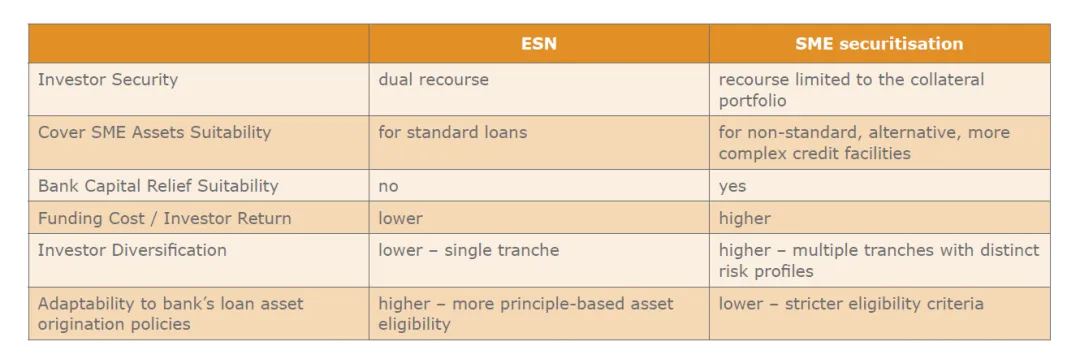
In this section we will address the refinancing of SME bank credit portfolios (SME assets) through complementary financial technologies and instruments, exploring the differences and the characteristics of both SME securitisation and European Secured Notes (meaning a dual recourse funding instrument collateralized by SME assets, to be regulated by a specific EU legal framework7). Our intention is to demonstrate that these instruments are indeed compatible and complementary and align with the objectives of the SIU. As you will read in the following paragraphs, securitisation is typically a tool fit for capital management and for the refinancing of certain categories of assets, whereas ESN is the most cost-efficient and best suited to be a pure funding instrument.
- Peculiarity of SME assets and their treatment in structured finance transactions
SME assets typically have a short to medium maturity (compared, for instance, to mortgages), and therefore need refinancing at a higher pace. In securitisation, issued notes repayment follows the amortization profile of the underlying portfolio. Therefore, in order to obtain a longer tenor on the notes, the portfolio needs a predefined replenishment period, when expiring assets are replaced with new ones, thus extending the amortization
period of the collateral portfolio. Typically, in a securitisation the characteristics of the replacement assets are set in advance in order to ensure
asset quality throughout the life of the transaction. The reason for adopting stringent criteria is the limited recourse nature of the issuance itself: the only claim that investors have is represented by the securitised portfolio, therefore its evolving composition needs to follow strict criteria to avoid its deterioration as the sole source to repay the notes.
Conversely, in a dual recourse transaction, like a covered bond – which ESNs aim to replicate – that feature, even if broadly inscribed in specific legislation, is somehow softened. This is because the features of CBs are different: (i) bonds are issued in the context of a programme, where its segregated portfolio (cover pool) must cover all issued notes, at all times (coverage requirement); (ii) the credit quality of the cover pool is managed
dynamically by the issuer, adjusting the OC levels in order to ensure adequate protection for investors and also ensuring the coverage requirement is continuously met by performing assets only, thus not considering non-performing receivables (this is not the case in securitisation); (iii) investors enjoy a first recourse on the issuer and, in case of issuer insolvency, or other contractual events, they have exclusive recourse over the cover pool; (iv) repayment of the bonds is typically through either bullet or soft bullet structures, instead of the amortising notes typical of securitisations.
According to the Covered Bond Directive the cover pool must be continuously adequate and cover principal, interest, and ongoing expenses. The eligibility criteria for replenishing assets mirror the initial collateral quality but allow more flexibility than securitisations. A similar requirement would be needed for an ESN legal framework.
Why are these features important? From a financial perspective, conditions evolve over the years and, for example, the interest accruing on the bonds may also increase or decrease over time. It is therefore essential to ensure the overall coverage of the interest payments on the bonds by the interest accruing on the evolving cover pool. Such considerations apply also to ESN as a dual recourse instrument.From a business perspective, the terms, sectors, and geographic distribution of SME loans may also change according to the bank’s commercial strategies. The issuance programme therefore ensures portfolio quality over time while allowing certain features to be adapted. This is critical for providing long-term funding stability to the issuer. Once set up, and as long as sufficient collateral exists, the issuer can issue notes based on market opportunities and its funding strategy.
On the contrary, securitisations are bespoke transactions, typically structured for a single issuance. For the SME sector this difference is crucial, and it is clear dual-recourse funding instruments would enable refinancing the issuer’s SME portfolio for longer periods of time, irrespective of changes in general financial conditions, or of how the issuer’s origination business evolves. On the other hand, once certain conditions are met, securitisation allows the originating bank to free up regulatory capital, as well as meeting different risk appetites through the issuance of senior and more subordinated tranches. Securitisation is also an efficient way to refinance less standard SME loans, whereas ESN, acting as a programme on larger volumes of collateral assets, may favour more standardised SME portfolios. In sum the two instruments – securitisation and ESN - are highly complementary and may both be used according to the objectives of the issuing bank and the respective market access windows.
- Requirements of the Securitisation legislative package
The Securitisation legislative package (a specific Regulation complemented by the CRR prudential provisions) was published in 2019. Over time, EU institutions have promoted securitisation to help develop the Capital Markets Union, encourage risk sharing through financial markets, and support financing for the real economy. Finally, in June 2025 the Commission published a proposal in order to simplify the framework by removing unnecessary burdens that do not enhance product robustness and have so far hindered the securitisation market’s recovery since the Great Financial Crisis. The legislative review aims at making the product more attractive for both issuers and investors, keeping a strong hand on prudential soundness. A new category of transactions has been introduced in the CRR (the resilient senior tranches), thus encouraging issuers in structuring transactions with such resilient features in order to achieve,inter alia, a less punitive prudential treatment. In the debate around the securitisation review, the importance of SRT transactions on SME and corporate assets has emerged and a more favourable prudential treatment would encourage lending to the SME and corporate sector.
The securitisation review is not completed yet (at the time of writing trilogues between the Commission, the Council of the EU and the European Parliament have just begun and will continue under the Irish Presidency), and EU institutions have rightfully intended to timely approve the new securitisation framework which is one of the main enabler of the SIU initiative. There are a couple of aspects worth mentioning on the treatment of SME securitisations. So far, residential mortgage-backed securities have been the main asset class of traditional (funded or “cash”) securitisation issuances. Rather complicated regulatory requirements have so far discouraged the execution of funded SME securitisations in many jurisdictions, while in some it has become an important asset class.9 As a more recent trend, SMEs are one of the main asset classes used for synthetic securitisations, where typically originators keep the assets on their balance sheet and only sell part of the risk to specialised investors. Synthetic SME deals have proven to be an excellent means for financial institutions to manage their credit risk (allowing for significant risk transfer, SRT) and capital needs, while promoting the participation of market players interested in investing in SME exposures.
- What role for ESN? And for securitisation?
An instrument governed by specific EU legislation and building on the dual recourse features, would appeal to both issuers and investors, with the dual protection conferring comfort to certain categories of investors, while allowing banks to issue lower risk bonds at spreads way lower than those expected for a securitisation deal or even for unsecured senior bond issuances. Let us briefly explore the motivations for issuers and investors.
ESN, as a pure funding instrument, would afford the issuer more time flexibility according to market opportunities (as do traditional covered bonds in the mortgage credit space), building on the ability of a dual recourse instrument to mitigate volatility in financial markets. In addition, ESN would allow adapting certain collateral characteristics over time, while preserving its overall main criteria and quality. Finally, it is important to mention
that covered bond programmes require dedicated internal structures and specific control functions – entailing structural and running costs – and a constant dialogue with supervisors. This is the reason why, in most countries, issuers are larger and more complex institutions. ESN would be subject to much of these features and conditions.
On the other hand, banks wishing to achieve both funding and capital relief for their SME portfolio may also use securitisation (traditional or synthetic), through bespoke transactions. Securitisations may be executed by banks under specific circumstances to refinance specific portfolios. They are one-off transactions where costs are primarily incurred at inception. For small portfolios (and often small institutions), securitisations are more widely used, notwithstanding the higher yield on the notes typically demanded by investors. In addition, less standard credit assets are likely to be more efficiently financed through securitisation.
Investors are bound by their specific guidelines and their risk-reward appetite. Therefore, those investors focusing on dual recourse instruments would evaluate the issuer’s strength and the analysis of the collateral would matter only for the recourse in case of issuer-related event of default. Investors specialized in securitisation, on the contrary, would focus on the collateral and on the structural features of the transaction, evaluating the specific risks embedded in the relevant transaction. A specific new EU legal framework for ESN would likely broaden the investor base, allowing also banks’ treasuries to play an important role, as it is already the case in the covered bond space.Finally, the first ESN issuances were launched in the financial markets between 2024 and 2026. Large institutions financing SMEs have been exploring all available tools to fund their portfolios, especially after the phase-out of the ECB’s TLTROs, which supported lending for years. Synthetic securitisations already provide capital relief and allow new lending within existing capital, but also this instrument needs regulatory updates
to unlock its full potential.
Although no dedicated EU legislation exists yet, some dual recourse transactions backed by SME portfolios have recently entered the market since 2024 and continued in 2025 and 2026, receiving public rating by major ECAIs. This shows a positive market reaction, long years since Commerzbank issued its only SME structured dual recourse € 500 mln bond more than a decade ago in a completely different financial environment. These recent deals demonstrate strong interest from issuers and investors in innovative SME-backed structures.
The pioneer was BPCE Group, which launched the first dual recourse SME backed deal in 2024, followed by the last transaction in 2025.11 Those deals were all rated (depending on the transaction, by Fitch and Moody’s) and all were privately placed, for a total amount of approx. € 1,15 bn.
Very recently, in May 2026, BPI France, owned by the French Government, published an ESN programme and marketed its first public transaction, rated by Moody’s. The book was well oversubscribed and ultimately BPI printed a € 750 mln issuance. To note that, while BPCE transactions show a conditional pass-through structure, BPI France chose soft bullet. These deals demonstrate strong interest from issuers and investors in innovative SME-backed structures. Those transactions show the importance that financial institutions (and investors) attribute to such type of product.
As no specific prudential treatment is foreseen yet,12 bank investors are, ceteris paribus, less incentivised to enter into this type of investment. However, we estimate that new transactions would increase significantly if tailored legislation for ESN were to be introduced.